Ruth: The Woman Who Gave Up Everything to Become Jewish
Ruth chose a new identity, a new people and a new way of life. Her story in the verses and in Chazal, and what it means for a conversion journey today.
By Rabbi Yitzchak Lasry
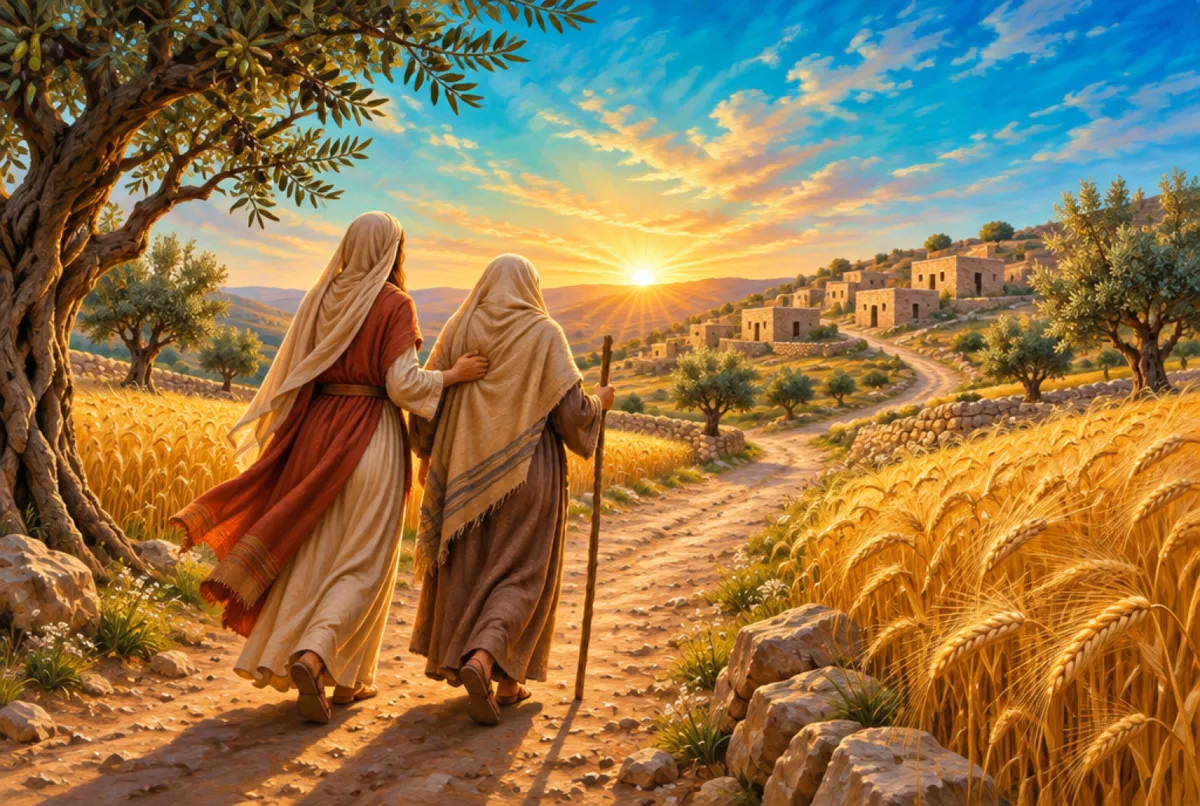
What would make a young widow leave her homeland, her family and everything familiar for a people she barely knew?
On the festival of Shavuot, when Jews mark the giving of the Torah at Mount Sinai, a short book about a foreign widow in a barley field is read aloud in many synagogues. It seems an odd match: a holiday about a mountain and thunder, and a book about gleaning grain.
Rabbi Lasry explains the connection in his lesson on the months of Iyar and Sivan, and the more you look at it, the more the match makes sense. This article follows what he teaches and sets it beside the Book of Ruth itself. Throughout, it separates what the verses say from what the Sages (Chazal) teach about them.
Ruth did not simply choose a new religion. She chose a new identity, a new people, and a new way of life. She left behind everything familiar, without knowing what the future would bring. Her decision was not based on comfort or personal gain, but on faith, love, and an extraordinary commitment to Hashem.
Quotations from the Bible below use the 1917 Jewish Publication Society translation, which is in the public domain. Quotations from the Talmud and other sources are our own paraphrase.
Why Ruth is read on Shavuot
Shavuot ("Weeks") is the holiday on which the Jewish people received the Torah. Megillat Rut, the Scroll of Ruth, is one of the five megillot (scrolls) of the Bible. The Rabbi notes that customs differ from community to community, including when during the holiday it is read. Some communities read it during the night of Torah study that marks the holiday, and others read it during the day. If you want to know what is done, ask in your own community. There is no single custom for everyone.
The Rabbi gives two reasons for reading it. The first is timing. The story takes place during the harvest season, which is the season of Shavuot. The Book of Ruth says that Naomi and Ruth came to Bethlehem "in the beginning of barley harvest" (Ruth 1:22), and that Ruth gleaned "unto the end of barley harvest and of wheat harvest" (Ruth 2:23). The Torah itself ties Shavuot to the harvest, counting seven weeks from the offering of the first sheaf to a festival of new grain (Leviticus 23:15-16).
The second reason is the message. The Rabbi teaches that Ruth shows what it means to receive the Torah when it is hard.
A person who left everything
Who was Ruth? The Book of Ruth calls her "Ruth the Moabitess" (Ruth 1:22), a woman from the nation of Moab, east of the Dead Sea. Her husband had died. Her mother-in-law Naomi, also a widow, decided to return to Judah and urged both her daughters-in-law to go back: "Go, return each of you to her mother's house" (Ruth 1:8). Ruth refused. Her answer is one of the most famous in the Bible: "whither thou goest, I will go; and where thou lodgest, I will lodge; thy people shall be my people, and thy God my God" (Ruth 1:16).
What Chazal say about her family. The Book of Ruth does not say that Ruth was royalty. The Sages teach it. The Talmud records that Ruth descended from Eglon, king of Moab, who descended from Balak: in one place she is called a daughter of Eglon (Sanhedrin 105b), and in another a granddaughter (Nazir 23b). In the Rabbi's telling, she left a royal background and ended up in a field with a poor woman. This is the Sages' tradition about her, and the verses themselves say nothing of it.
Chesed, which the Rabbi names as one of the story's central lessons, means loving-kindness: generous action done for others without expecting anything in return.
What the verses say, and what Chazal learn from Naomi and Ruth
The verses are brief. After Ruth's declaration, the text says: "And when she saw that she was stedfastly minded to go with her, she left off speaking unto her" (Ruth 1:18).
The Sages read more into this verse. In Yevamot 47b the Talmud teaches how a Beit Din (a rabbinic court) should treat a person who comes to convert: the court informs the person of some of the lighter and some of the heavier mitzvot, and does not overwhelm him with warnings or press for every detail. Rabbi Elazar finds the source in this verse: once Naomi saw that Ruth was determined, she stopped trying to dissuade her.
The Talmud then reconstructs what Naomi said to Ruth, step by step, and how Ruth answered. This conversation is the Sages' interpretation. It is not written in the verses. As the Talmud presents it:
- Naomi told Ruth that on Shabbat we may not walk beyond the Shabbat limit. Ruth answered, "whither thou goest, I will go."
- Naomi told her that we may not be alone with a man with whom relations are forbidden. Ruth answered, "where thou lodgest, I will lodge."
- Naomi told her that we are commanded in 613 mitzvot. Ruth answered, "thy people shall be my people."
- Naomi told her that idol worship is forbidden to us. Ruth answered, "and thy God my God."
- Naomi told her that the court has four death penalties for those who violate the Torah. Ruth answered, "where thou diest, will I die" (Ruth 1:17).
- Naomi told her that the court has two burial places. Ruth answered, "and there will I be buried" (Ruth 1:17).
Chazal read Ruth's well-known words as an acceptance of Jewish life. From this conversation they learn how a candidate is examined: the court explains what is involved, including the daily mitzvot and the weight of the commitment, and then listens to the answer. When the person is determined, the court does not keep discouraging him (Yevamot 47b). Notice what is being taught. Joining the Jewish people means taking on Shabbat, modesty, the whole body of mitzvot, and a shared fate with a people. Ruth heard all of this, and she did not turn back.
The field
Ruth had no land and no income. The Torah, however, requires farmers to leave the edges of their fields and the gleanings of the harvest for the poor and the stranger (Leviticus 19:9-10; Deuteronomy 24:19). So Ruth went out to glean and came to a field that belonged to Boaz, a relative of her late father-in-law (Ruth 2:1-3).
Boaz had heard about her. He says: "It hath fully been told me, all that thou hast done unto thy mother-in-law since the death of thy husband; and how thou hast left thy father and thy mother, and the land of thy nativity, and art come unto a people that thou knewest not heretofore" (Ruth 2:11). What he values is her loyalty, shown in daily actions toward someone who could do nothing for her.
From a Stranger in the Fields to the Royal Family of Israel
The book begins with a destitute Moabite widow gleaning behind the harvesters. It ends with a family tree. Boaz took Ruth as his wife, and she bore a son (Ruth 4:13). The neighbors named him Obed, "he is the father of Jesse, the father of David" (Ruth 4:17). The book closes with the line of descent from Perez to David (Ruth 4:18-22). That makes Ruth the great-grandmother of King David.
Jewish tradition looks forward to a king descended from David. Maimonides writes that in the future the Messianic king will arise and restore the Davidic kingdom (Mishneh Torah, Laws of Kings and Wars 11:1). So the tradition of the Messiah from the House of David also passes through the woman who came from Moab with nothing.
The Rabbi puts the message this way: a person who joins the Jewish people sincerely and with devotion can reach high spiritual levels, whatever their origin. David descends from a woman who dedicated herself to joining the Jewish people. This is a lesson about dedication. It is not a promise about the outcome of any individual's conversion, which is decided by a Beit Din.
What Ruth's Story Means for Your Conversion Journey
If you are considering converting to Judaism, Ruth's story carries a powerful message. You may face difficult decisions. You may need to change your lifestyle, move closer to a Jewish community, observe Shabbat, or leave behind habits that have been part of your life for years. Ruth reminds us that genuine commitment is not measured only by what we believe, but by the choices we make and the life we are willing to build. She did not know what the future would bring. She simply knew where her heart and faith were leading her. Her story teaches that the path toward joining the Jewish people is not merely about learning Jewish laws. It is about becoming part of a people, embracing a covenant, and living according to the Torah.
Ruth did not choose the easiest path. She chose the path she believed was right. And that choice changed her life and left a lasting mark on Jewish history.
Ruth's story is a Bible narrative, and the Sages' reading of it as a model for how a court treats a seeker (Yevamot 47b) is tradition built on that narrative. Neither replaces the process of conversion today, which is decided by a Beit Din. No story and no course guarantees an outcome. To see how the process works, read How Does Orthodox Conversion Work? To understand why a rabbi may begin with questions and difficulties, read Why Doesn't Judaism Seek Converts?
Reflection questions
- Which of Ruth's choices is hardest to imagine making: leaving her homeland, staying with Naomi, or going to glean?
- Boaz praises Ruth for her actions, not her words. What does that suggest about what people value in each other?
Key takeaways
- The Book of Ruth is read on Shavuot because it takes place at the harvest season and because it shows what accepting the Torah can ask of a person.
- Ruth's declaration of loyalty (Ruth 1:16) and her daily kindness, rather than titles or origins, are what the story honors.
- In Yevamot 47b the Sages learn from Naomi and Ruth that a sincere seeker is informed about the mitzvot and the weight of the commitment, and is not endlessly discouraged.
- Ruth became the great-grandmother of King David (Ruth 4:17-22).
An invitation
If you are thinking about Orthodox conversion, Lasry Academy offers a structured course of study in Jewish belief, practice and the calendar. The course does not guarantee conversion, which is decided by a Beit Din. Your first 15-minute consultation with Rabbi Yitzchak Lasry is completely free.
Book your free 15-minute consultation
Learn more on the Orthodox Conversion Course page.
Ready to Begin Your Jewish Journey?
Discover our structured Orthodox Conversion Course with Rabbi Yitzchak Lasry. Learn about Jewish faith, Shabbat, Kashrut, Jewish holidays, prayer, and the practical steps toward Orthodox Jewish life.
Study online, receive guidance, and prepare for the conversion process with the support of a Jewish community and a sponsoring rabbi.
Your first 15-minute Zoom consultation is completely FREE.
Completing the course does not guarantee conversion. The decision belongs to the Beit Din.